
The Navy’s history in Bayview begins not with submarines, but with massive, rapid wartime expansion.
In March 1942, shortly after the attack on Pearl Harbor, the Navy sought a safe, inland location far from the coast to train hundreds of thousands of new recruits. They selected a site on the southern tip of Lake Pend Oreille, near the small town of Bayview.
- Farragut Naval Training Station was broken ground on and built with astounding speed. By September 1942, the base had an estimated population of 55,000, temporarily making it the largest “city” in Idaho.
- Over its 30 months of operation during World War II, Farragut trained over 293,000 sailors, making it the second-largest naval training center in the world (after Naval Station Great Lakes).
- The base was decommissioned in 1946, and much of the land was eventually transferred to the state, becoming the Farragut State Park we know today
🤫 Why Lake Pend Oreille is a Submarine Test Bed
When the training base closed, the Navy held onto a small piece of land near Bayview. They didn’t need the barracks, but they desperately needed the lake.
In the post-war era, the US Navy shifted its focus to stealth in submarine warfare. The quietest sub wins the Cold War. To develop this technology, they needed a body of water with three specific, rare characteristics—and Lake Pend Oreille provided them all:
- Extreme Depth: The lake is one of the deepest in the United States, plunging to depths of 1,150 feet (350 meters) near Bayview. This depth is vital for acoustic testing, as it creates an environment that closely mimics the deep, free-field ocean conditions without the inherent noise, cost, and logistics of open ocean testing.
- Quiet Environment: The lake’s steep, sparsely populated, tree-lined shores and the naturally flat, muddy bottom minimize ambient noise. Testing is typically done at night when boat traffic is minimal, ensuring that highly sensitive hydrophones (underwater microphones) placed on the lake bottom can accurately measure the tiniest sound signatures of the test vessels.
- Constant Temperature: The water temperature below 100 feet remains a constant, chilly 39 degrees year-round. This constant temperature prevents thermal layers from forming that would distort sound waves, which is crucial for collecting accurate acoustic data.
🔬 The Acoustic Research Detachment (ARD) Today
The facility is now known as the Acoustic Research Detachment (ARD), a branch of the Naval Surface Warfare Center. It is far from a full naval base and does not operate battle-ready nuclear submarines.
Instead, the ARD is the Navy’s premier facility for acoustic structural measurements and has been integral to the design of virtually every major submarine class since the 1950s.
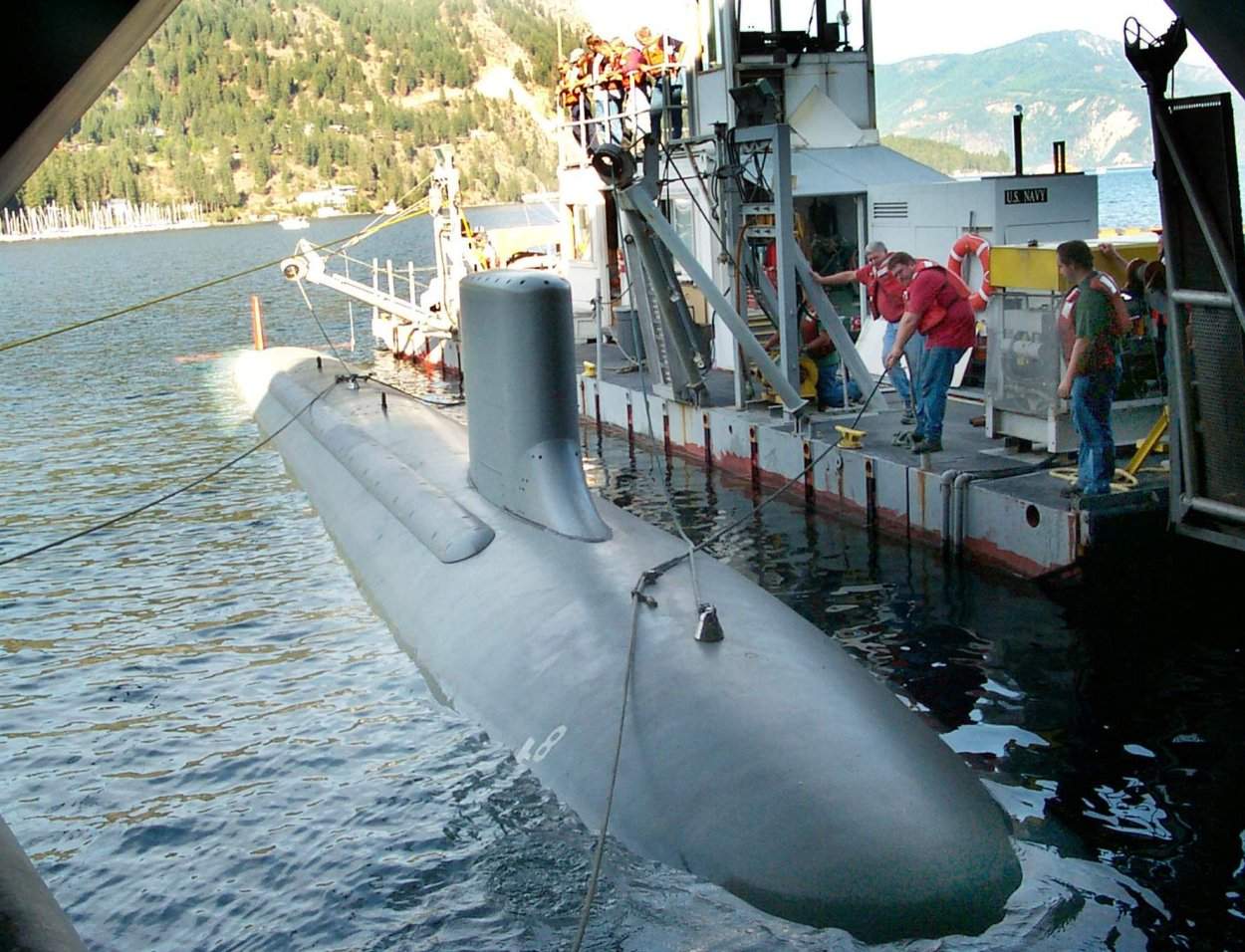
- The Fleet: The ARD’s “fleet” consists of specialized, unmanned, scale-model submarines. These can range from 1/4-scale models (like the Kokanee) up to the Large Scale Vehicle-2 (LSV-2) Cutthroat, a 110-foot-long vessel designed to test features of the Virginia-class submarines.
- The Mission: These test platforms are equipped with prototype hull shapes, propulsion systems, and acoustic dampening treatments. They are run silently across the deep acoustic range, while technicians record every sound to ensure future Navy submarines are the quietest in the world.
- Surface Ships: The ARD also tests models of surface ships, such as the Sea Jet, a 1/4-scale model of the advanced Zumwalt-class destroyer, used to test its unique propulsion and stealth capabilities.
So, while you won’t see a Trident submarine pulling into Bayview, the small, highly secretive base on Lake Pend Oreille truly is Idaho’s submarine base, providing a unique and vital service that saves the Navy billions and ensures the success of the modern fleet.
